

Triquetra for Healing
Triquetra for Healing
Triquetra for Healing by Julia Sinelnikova
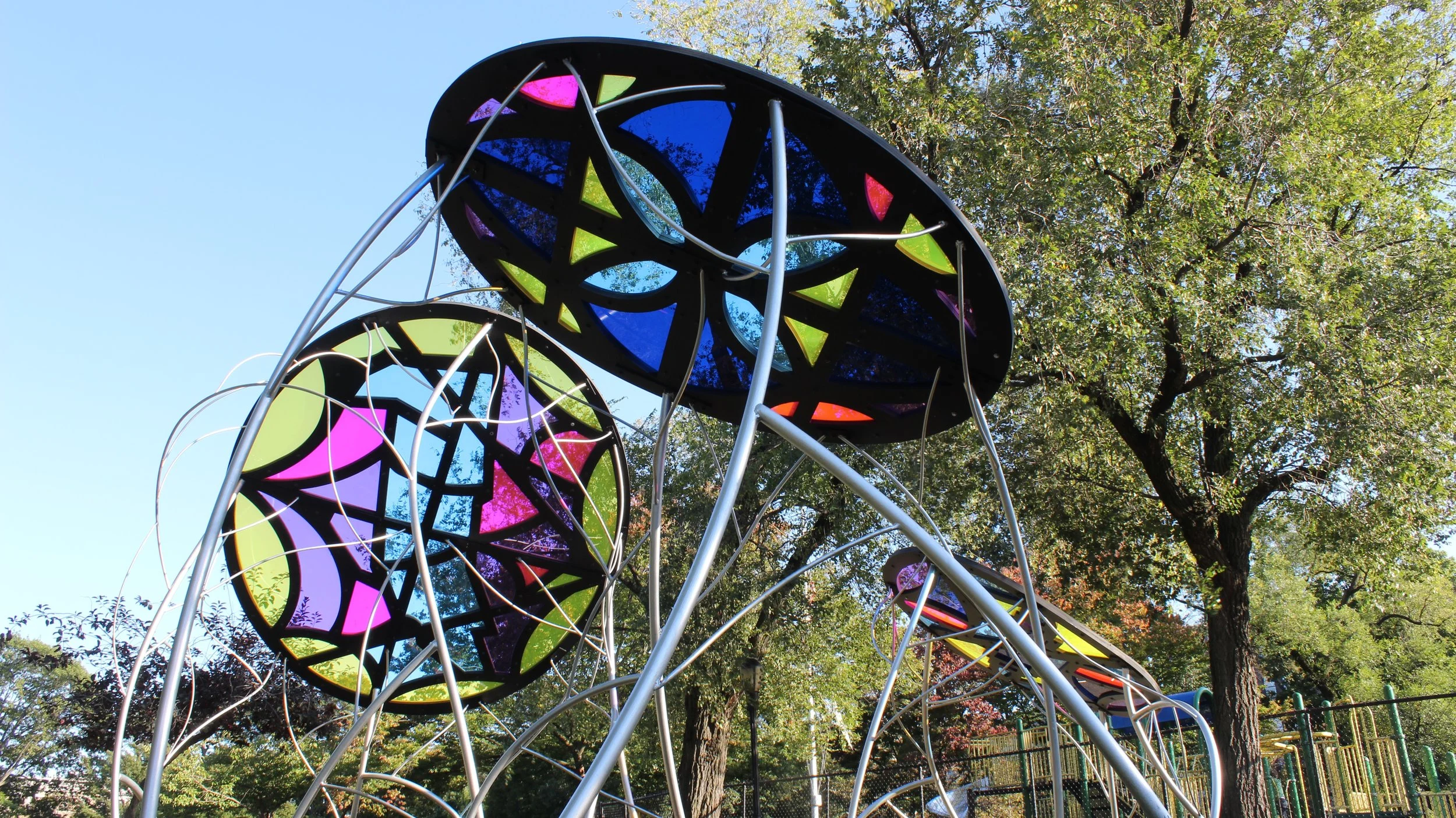
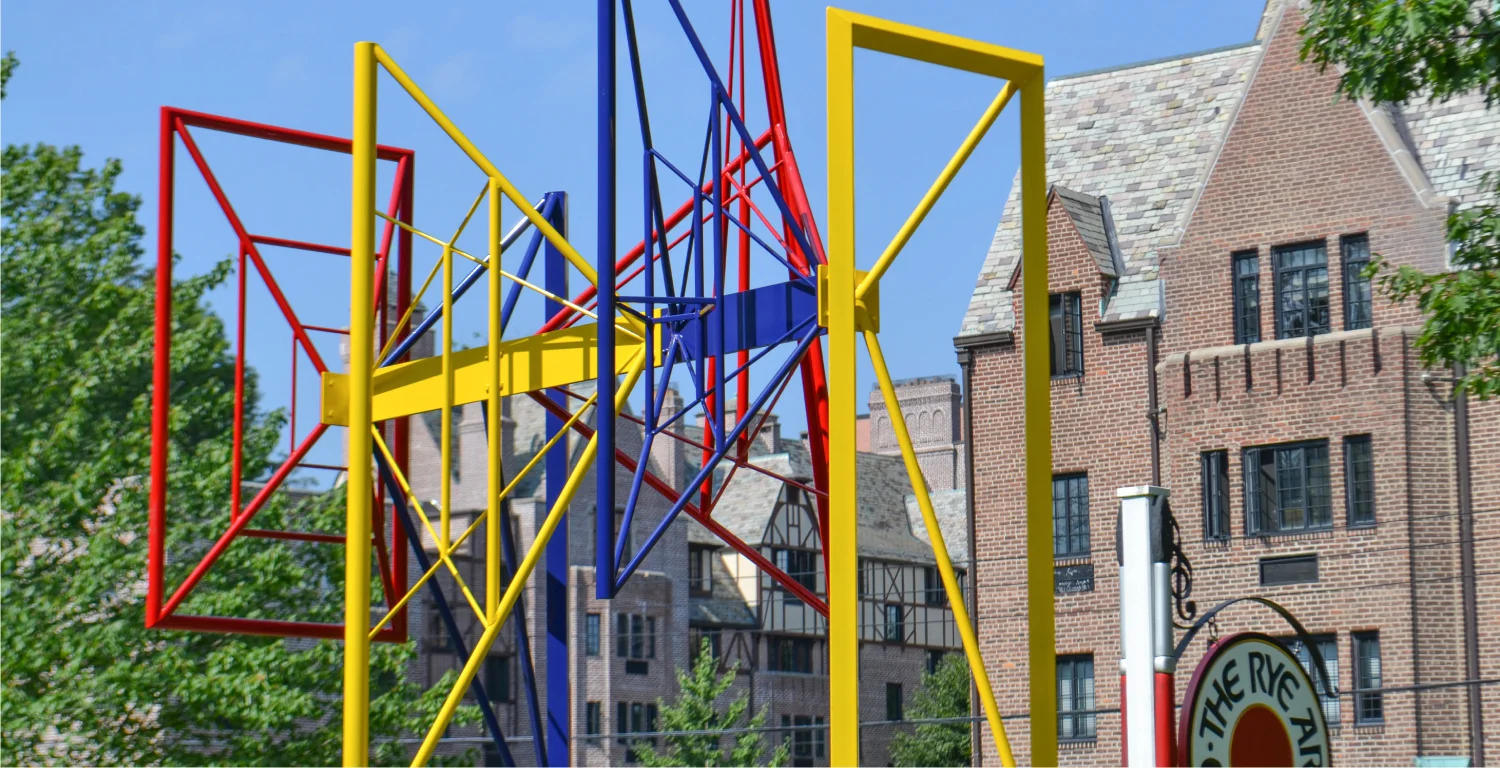
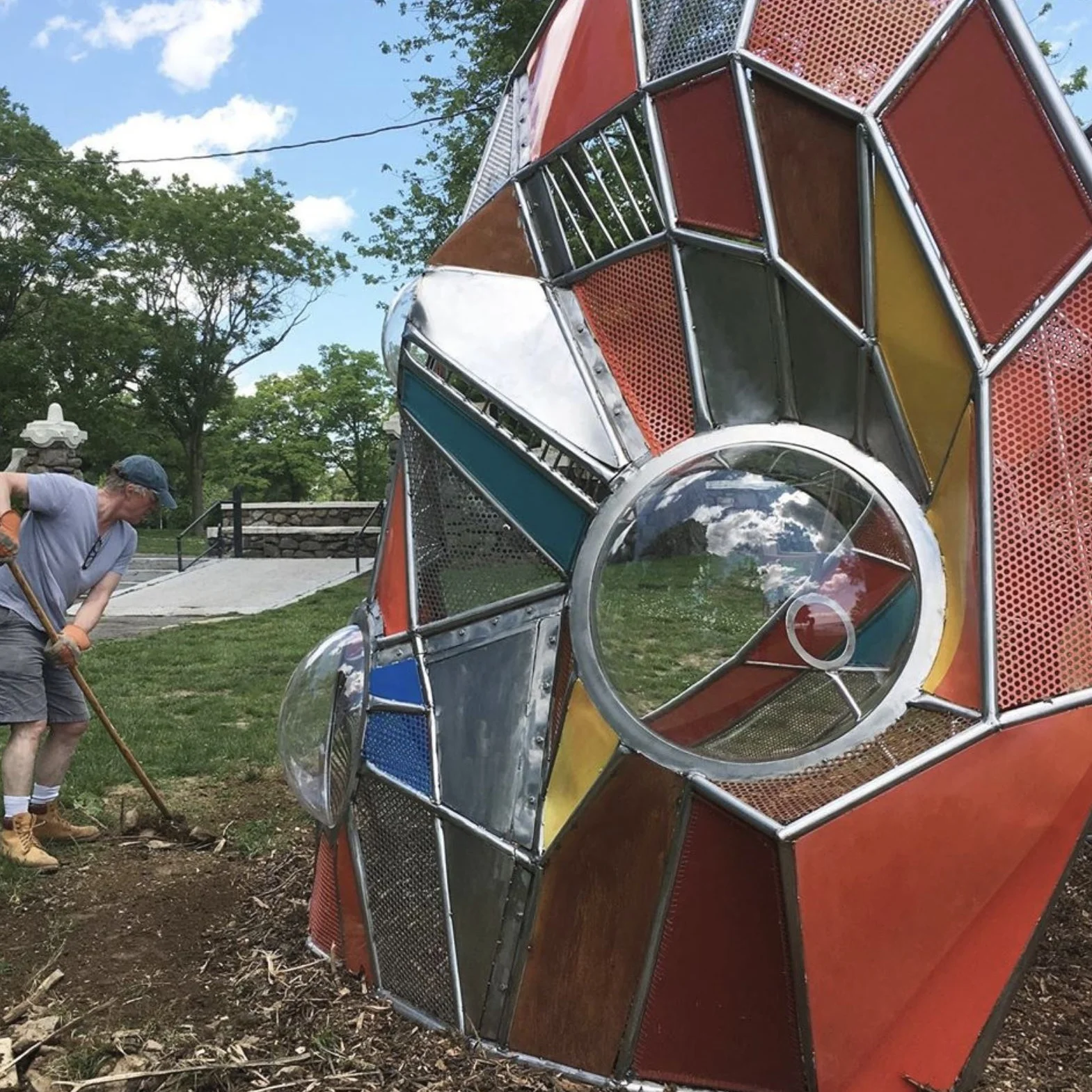
Triquetra for Healing by Julia Sinelnikova, gives us just one more reason to spend some time outside before it gets cold.
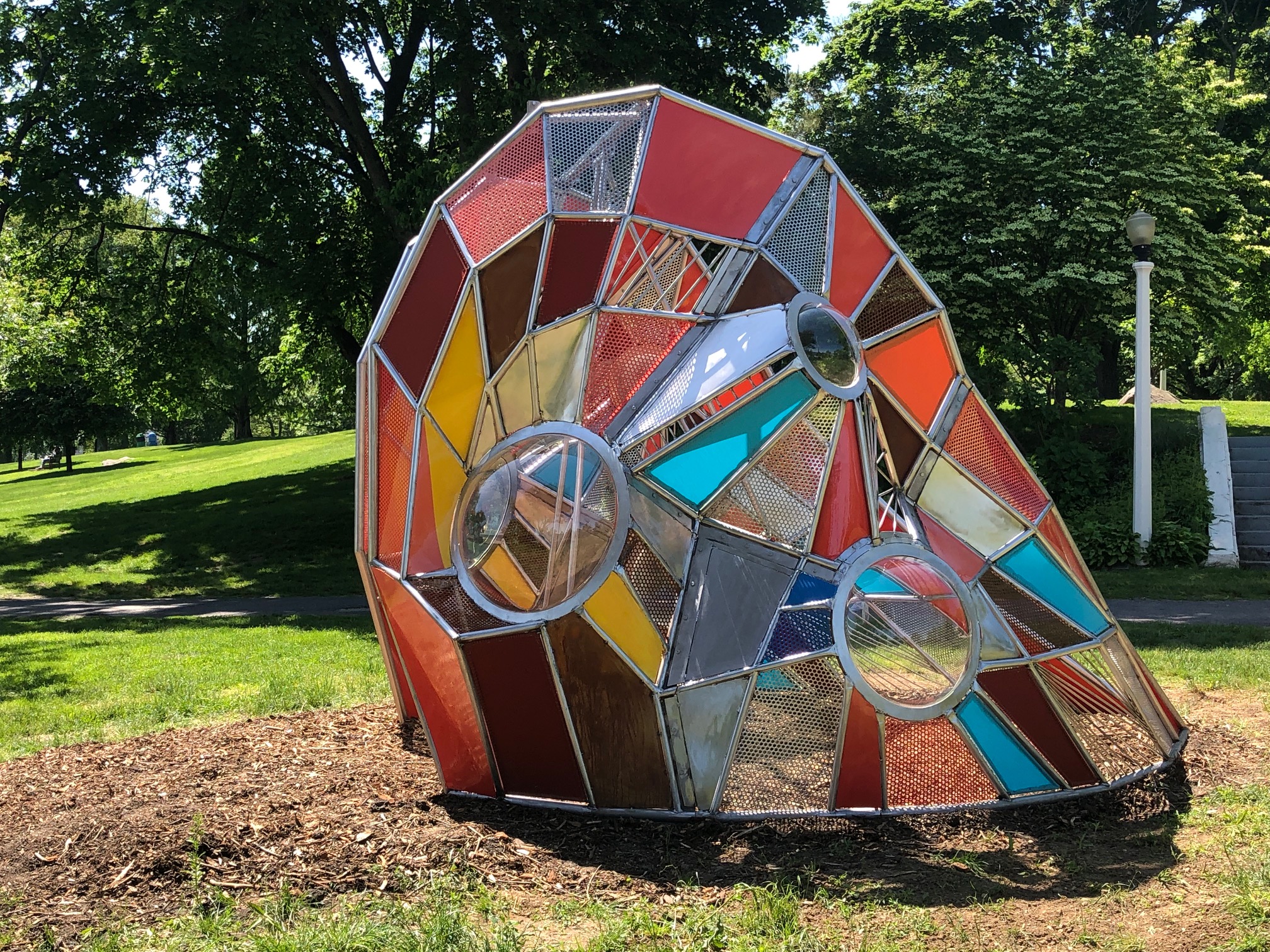
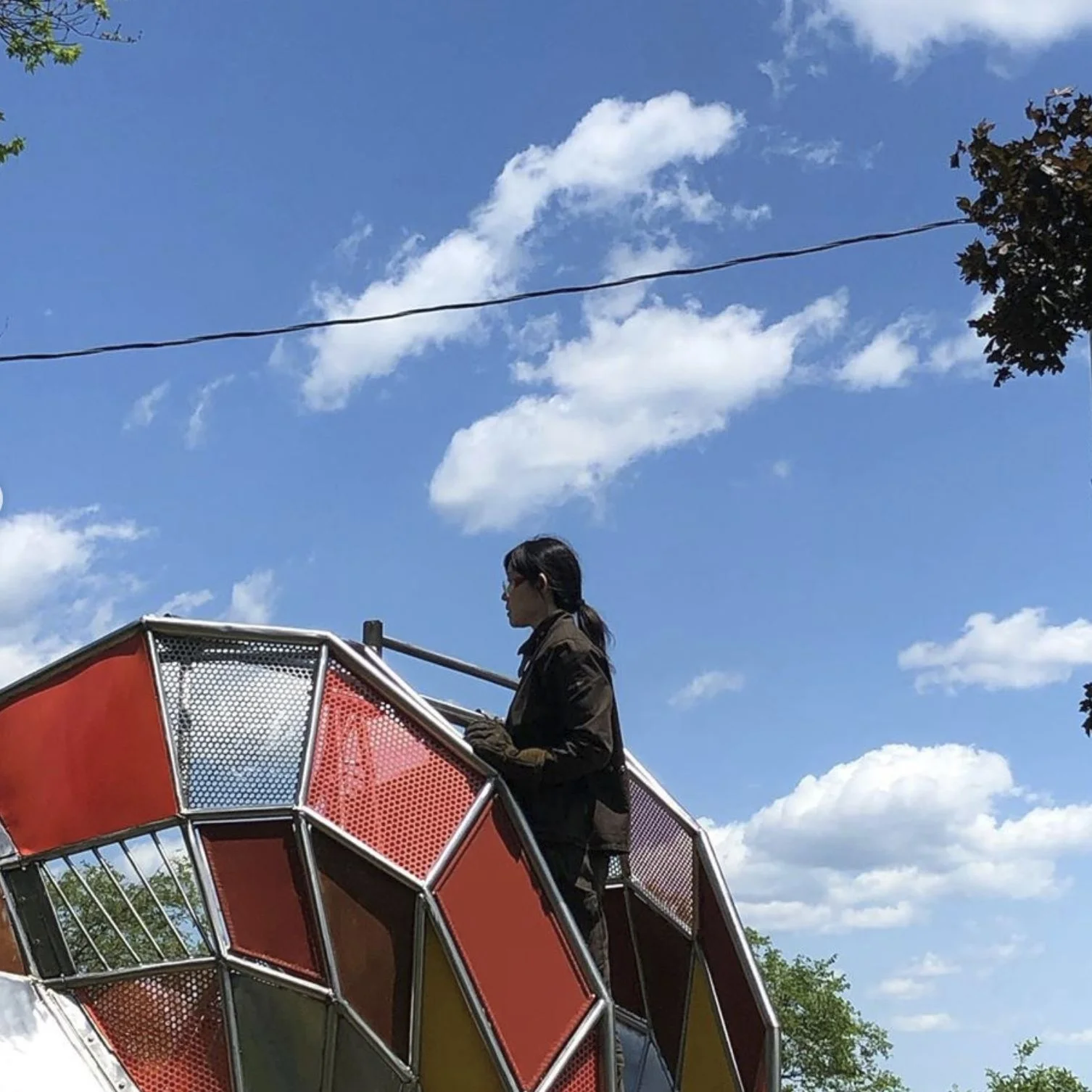
Ranging from seven to ten-feet-tall these three modular hand-welded steel sculptures have curvy legs and large flat discs at their centers. Each centerpiece has transparent colored acrylic panels that are modeled after geographical borders and inspired by both the concept and design of the “mandala”. The panels create healing light patterns that filter to the ground in a stained-glass effect.
Triquetra for Healing represents the power of unity and healing. It aims to bring neighborhood residents of all ages together to enjoy the alluring light effects from the sun.
“Transparency and light are key elements in my sculptural work, in both concept and technique. Living in a world greatly controlled by technology, I utilize transparent sculpture elements and light play as a metaphor – intangible structures controlling physical space, just as digital functions control human life. The development of immersive environments which can be interacted with by the audience is my primary artistic focus, in an age when art is increasingly presented in 2D and digital formats.”
- Artist, Julia Sinelnikova
Sinelnikova is an interdisciplinary artist who works with holograms, performance, and digital culture. Her light installations have been exhibited internationally, and she has performed widely as The Oracle of Vector Gallery. She has received commissions from NYC Parks Department, Pace University, Michael Madden (Maroon 5), and more. Selected profiles of her work have appeared in The New York Times, The Wall Street Journal, VICE, Artnet, Huffington Post, and more. Her work has been presented at the Contemporary Art Museum of Houston, The Oulu Museum of Art, and Williamsburg Art & Historical Center. She holds a BFA in Sculpture from The Fashion Institute of Technology (SUNY). She lives and works in Brooklyn, NY.
Triquetra for Healing was installed in front of The Rye Arts Center on Friday, October 5 and has remained on view into the summer of 2019. A free Artist’s Talk with Julia Sinelnikova was held on Thursday, October 25, 5:00 - 7:00 PM.
This installation is part of The Rye Arts Center Public Art Initiative, spearheaded by local artist, Bob Clyatt. This program is made possible by grants from ArtsWestchester, The New York State Council on the Arts, and The Westchester Community Foundation, and through the generous support of hundreds of donors and members.
The DNA Totem
The DNA Totem
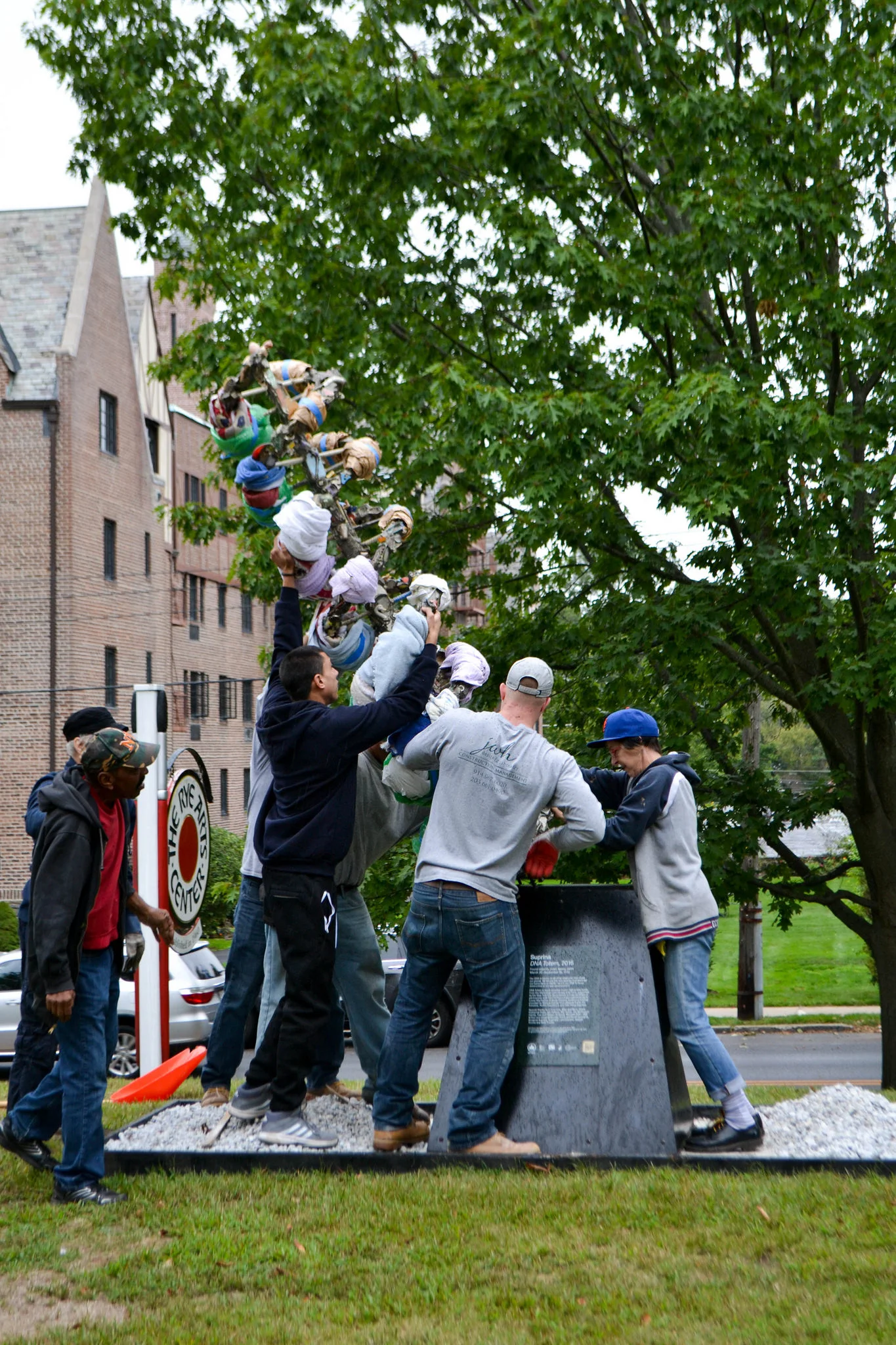
The DNA Totem
by Suprina
at The Rye Arts Center
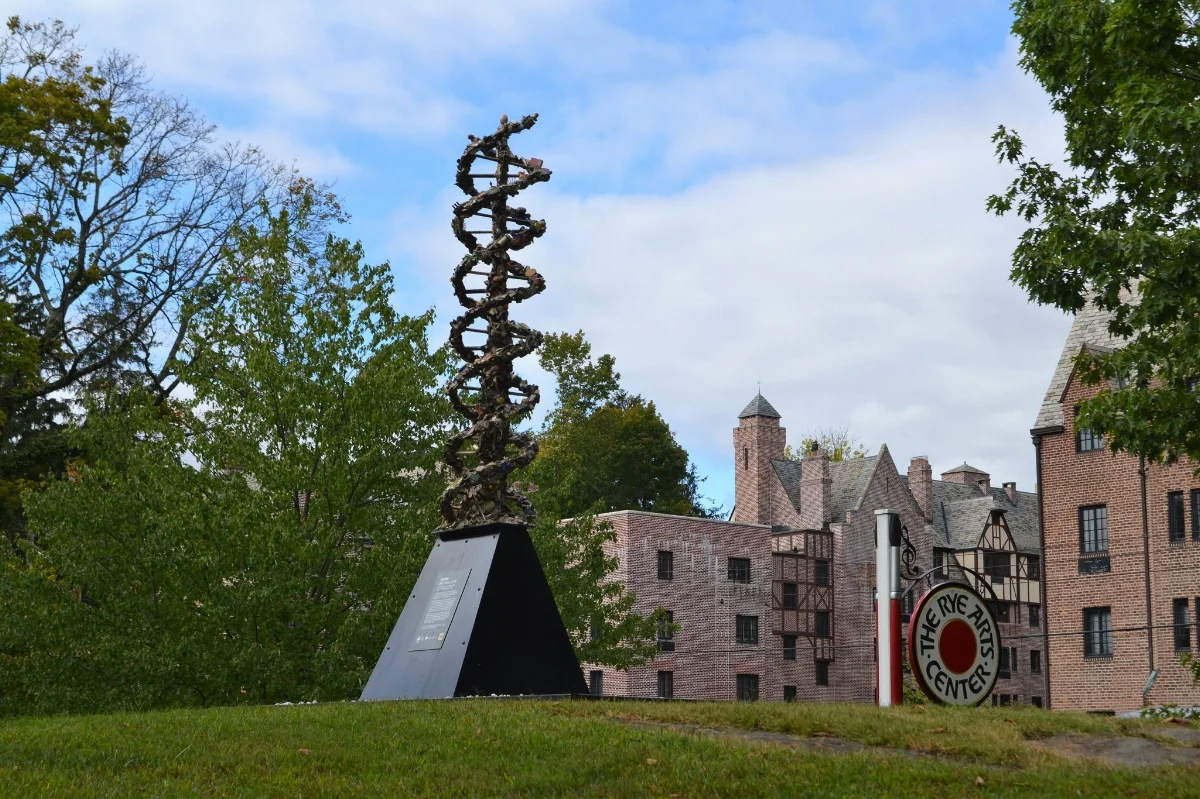
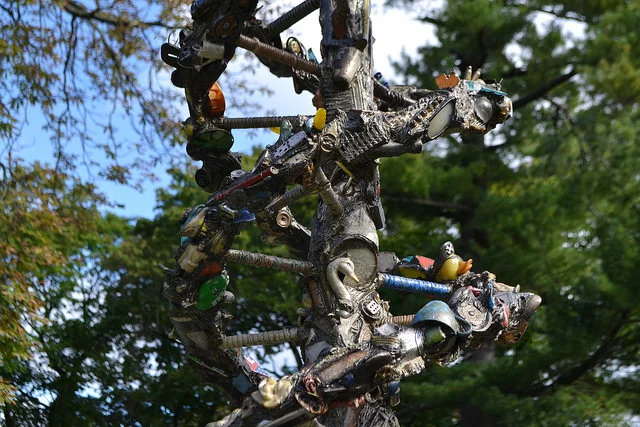
One man’s trash is another woman’s sculpture. The newest work presented through The Rye Arts Center’s Public Art Initiative is The DNA Totem by Suprina. This thought provoking piece is a 9’6” high model of a DNA strand made of steel. The steel frame is embedded with hundreds of found objects, attached with epoxy, and coated with metallic/UV rated paint.
The looming structure serves as a reminder of the footprint we leave behind. Through her sculpture, the artist asks, “Is it in our DNA to be so destructive to our home?” She explains, “The sculpture is meant to bring up for discussion why we humans, who have such a similar DNA to all the other creatures of the Earth, are destroying our habitat. All other animals only produce waste the Earth can assimilate.”
Suprina is a New York-based sculptor. She shows in galleries in Chelsea, Harlem, Brooklyn, Jersey City, Newark, Morristown, Governor’s Island, Chicago, Scottsdale, and The Monmouth Museum, NJ.
The techniques used by the artist in this sculpture are not new to many students at The Rye Arts Center which offers classes in recycled art, mixed-media assemblage, and creative building.
“I am excited about this piece because it goes well beyond aesthetics. The DNA Totem serves as a catalyst for conversation.” says Meg Rodriguez, Executive Director of The Rye Arts Center. “It is a perfect example of art helping to promote positive change in the community.”
The DNA Totem will remain on the lawn of The Rye Arts Center (51 Milton Road, Rye) through the year.
Cope
Cope
Cope by Damien Vera
Located in Rye Town Park
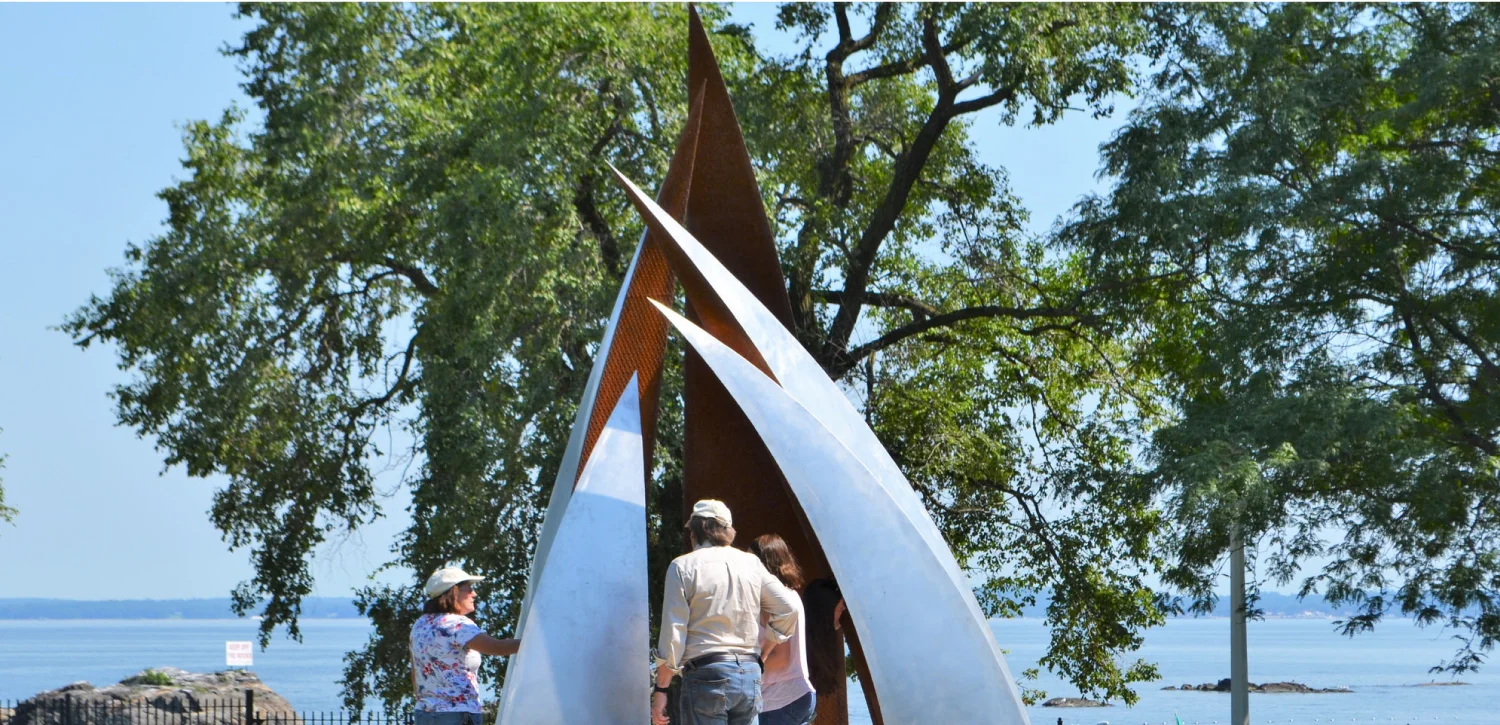
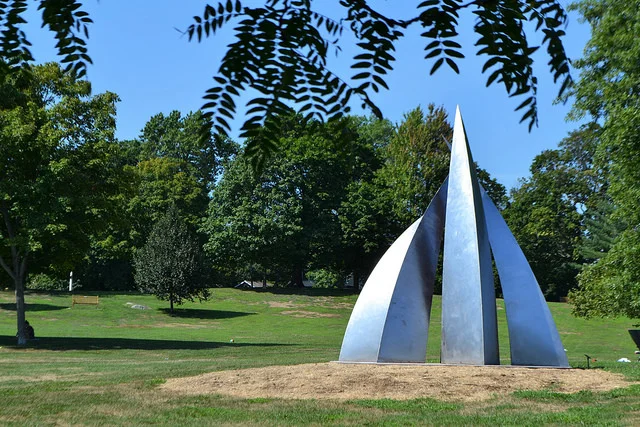
A walk in the park just got a little more interesting. Damien Vera’s Cope has found a home in Rye Town Park. The 14-foot steel sculpture was originally exhibited in New York City’s Riverside Park in 2012. It is on display in Rye Town Park as part of The Rye Arts Center’s Public Art Initiative.
“Cope is a wonderful addition to Rye Town Park,” says President of the Rye Town Park Commission, Gary Zuckerman. “It adds another dimension to the concept of enhancing the passive uses of the Park. Placing artistic endeavors within its natural beauty further adds to Rye Town Park’s symmetry and elegance. We welcome similar ideas from all of the Park’s stakeholders.”
The sculpture is comprised of five curved structures of varying heights. The outward-facing sides of each are made of smooth stainless steel. The inward-facing sides consist of a more harsh and industrial-looking, rusted steel.
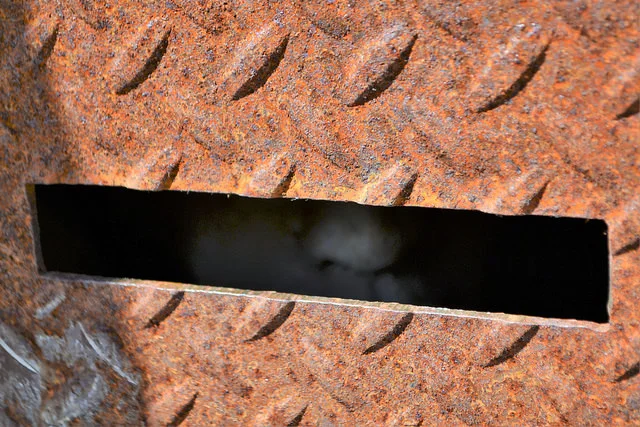
Detail of Cope
Encased within each tower is a cast stone sculpture of a human figure. These hidden statues are only visible through a small slit in each tower. They will go completely unnoticed by most people as they pass by. “I want it to be for curiosity,” explains Vera whose goal for the piece was to create an environment with which the viewer can interact. It serves as a reward for the more inquisitive viewers who take the time to engage with the piece.
Cope tells two stories. From the outside, it is abstract, strong, and shining; something to add a creative flare to the landscape. Cast against the seaside part, some may see the structures as sails or fins, others may see the sculpture as a giant claw breaking through the earth. But, once you climb into the space between the five towers, the work transforms. Only then, do you see the raw and rusted steel and the small openings through which you can view the isolated human figures.
This sculpture is the newest installment of The Rye Arts Center’s Public Art Initiative. Local artist, Bob Clyatt, who has been instrumental to this project says, “Damien’s work is a great example of the caliber of sculpture that we can hope to bring here in the years ahead through The Rye Arts Center Public Art Initiative — it enriches our community and creates an opportunity for artists to generate excitement about their work.”
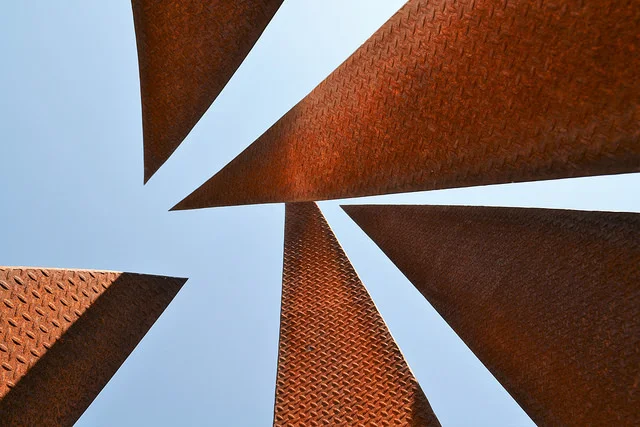
View of Cope, looking up
Synergy
Synergy
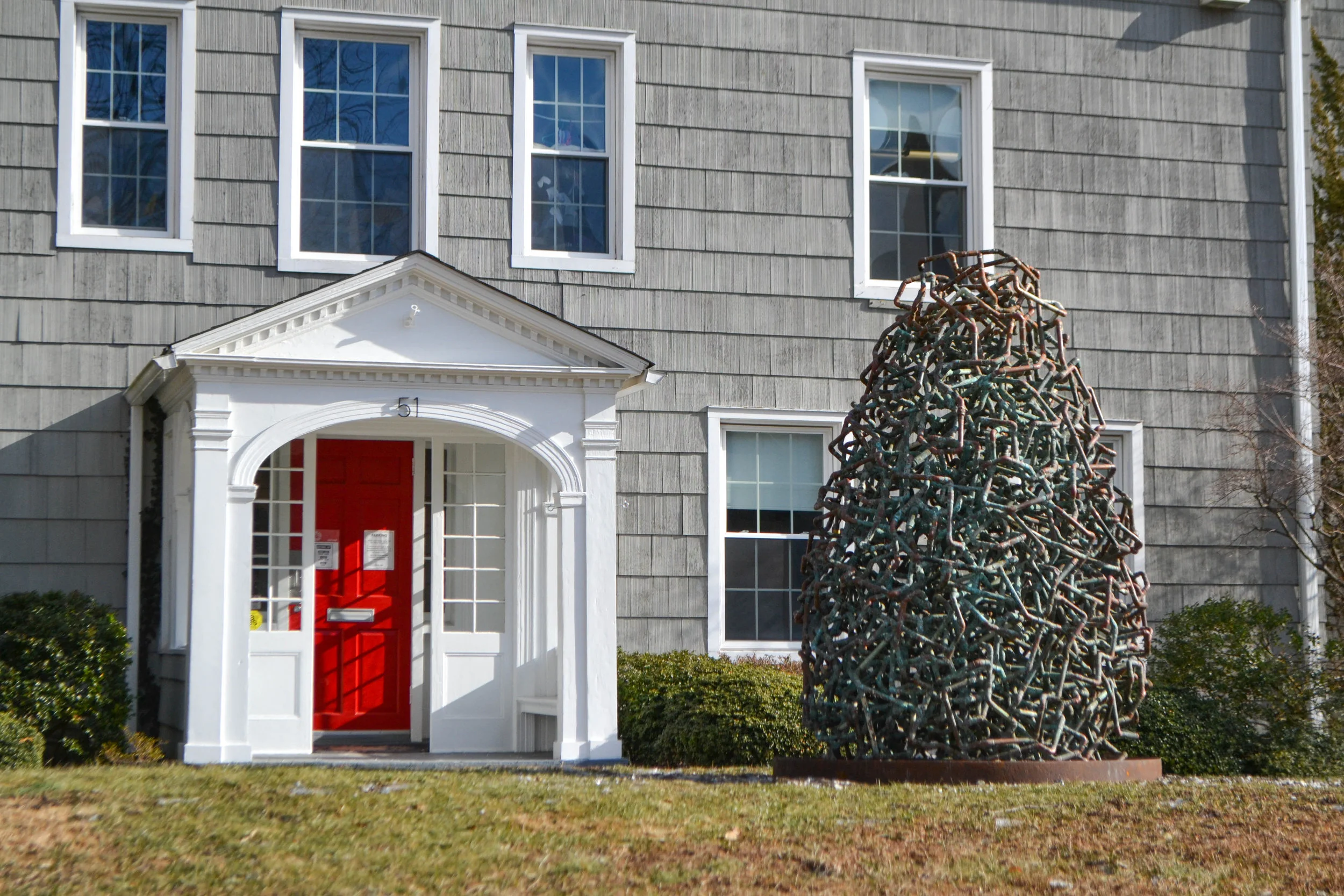
Synergy by Brent Crothers
2015 - 2018
Copper fittings and pipes
68 x 44 x 44 inches
(part of the "Water Wars" series)
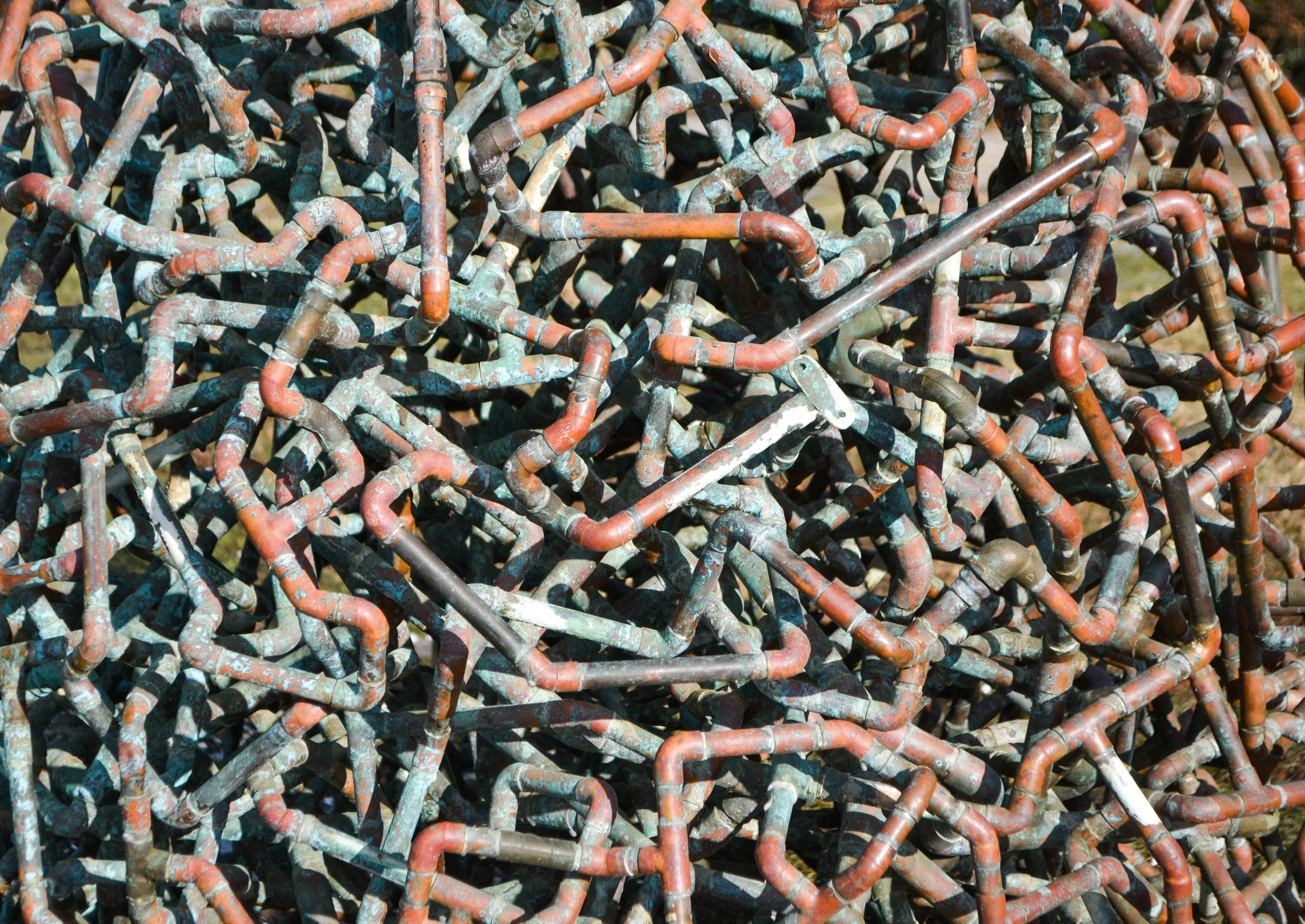
Synergy by Maryland artist, Brent Crothers, is constructed of countless recycled copper fittings and pipes soldered together to create a nearly six-foot tall egg-like sculpture.
The copper pipes are a rather fitting medium for Crothers, the son of a plumber. Synergy is part of a series he developed called the Water Wars Series.
"My brother knew I'd been sick for a long time and called to tell me that the price of scrap copper was higher than it had ever been, so one day I walked up to the studio with the intention of gathering the copper for recycling to bring in a little cash. It only took moments for me to realize that there was too much beauty, too much history in these old pipes and fittings to recycle in that manner. Thus started the 3 year project to create this sculpture now known as Synergy. Many memories merging to make a difference." - Brent Crothers
When Crothers was twenty-four he purchased twenty acres of undeveloped forest where he began following his artistic intuition, using the materials of the forest create works. He honed his skills at the Maryland Institute College of Art and the Rinehart School of Sculpture where he earned his MFA.
His works have appeared in a number of museums such as The Baltimore Museum of Art, The Delaware Museum, and The Art Museum of The America’s in Washington, DC. His sculptures are included in numerous private and public collections both domestic and overseas.
Synergy will remain on view through the spring of 2018. It is part of The Rye Arts Center’s Public Art Initiative spearheaded by local artist, Bob Clyatt. This program is made possible in part by grants from ArtsWestchester and The New York State Council on the Arts as well as a grant from The Westchester Community Foundation.
Installed: February 2018

Click below to download the free app, Otocast, to explore various audio tours from multiple locations!
What is Magic? Jeila Gueramian
What is Magic? Jeila Gueramian
Laura R. Lavan
Laura R. Lavan
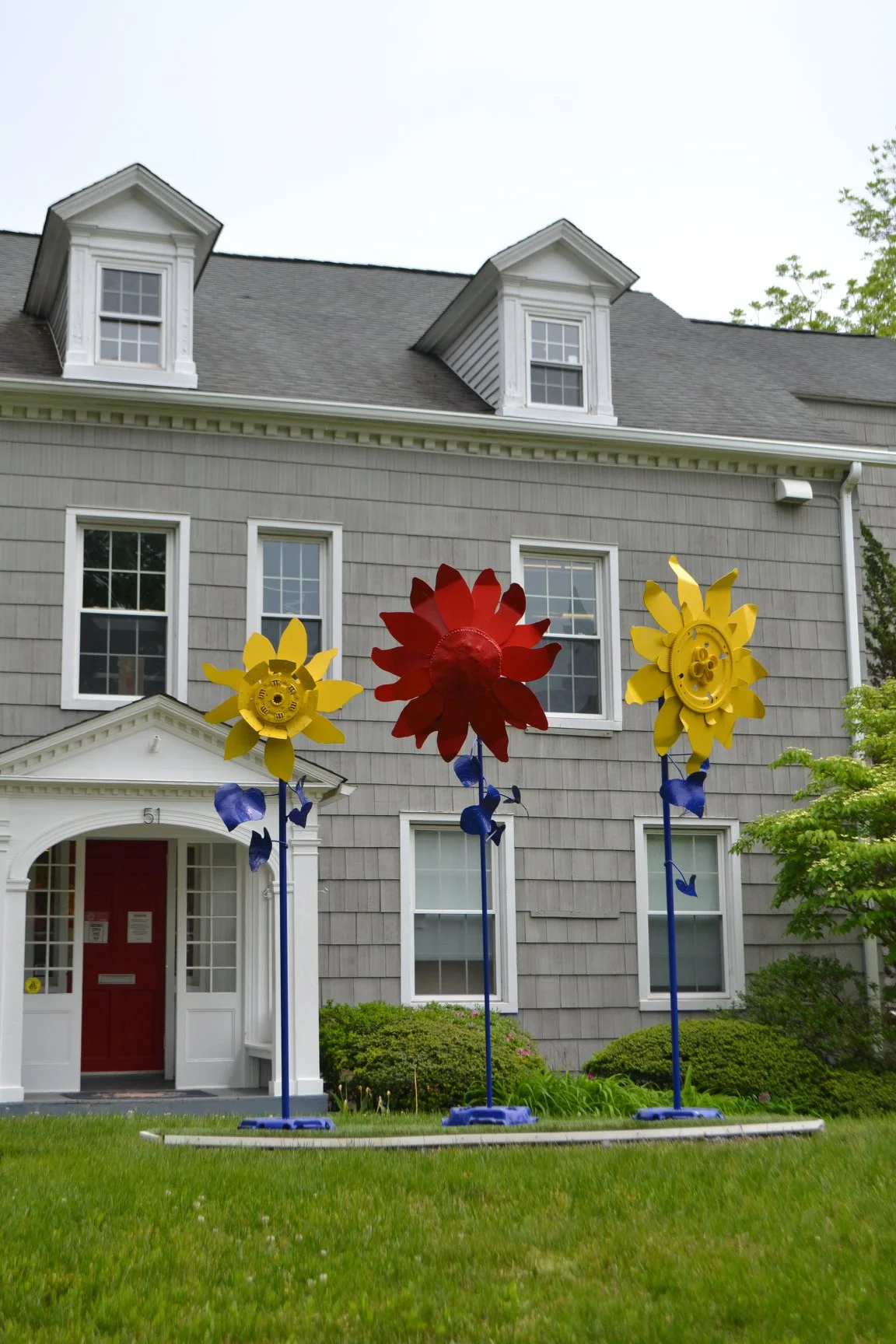
Flowers (#1,# 2,#3)
2017
Polychrome Steel
Laura R. Lavan
New York metal sculptor and painter
Laura is an award-winning artist and past member of Mamaroneck Artists Guild (MAG). She's studied various art mediums and in the last decade primarily with Brigitte Loritz (at The Rye Arts Center), Mel Stabin, Michael Dollar, David Dunlop, Robert Perucci and Mark Andreas of Silvermine Art Center, New Canaan, CT. Lavan’s work has been collected by both public and private collections in primarily in CA, CT, NY, and MA.
All proceeds are donated to The Boys and Girls Club of Mount Vernon and The Rye Arts Center.
Price: $2,150 per flower
Visit LauraRLavan.com for more.
Private Horizon
Private Horizon
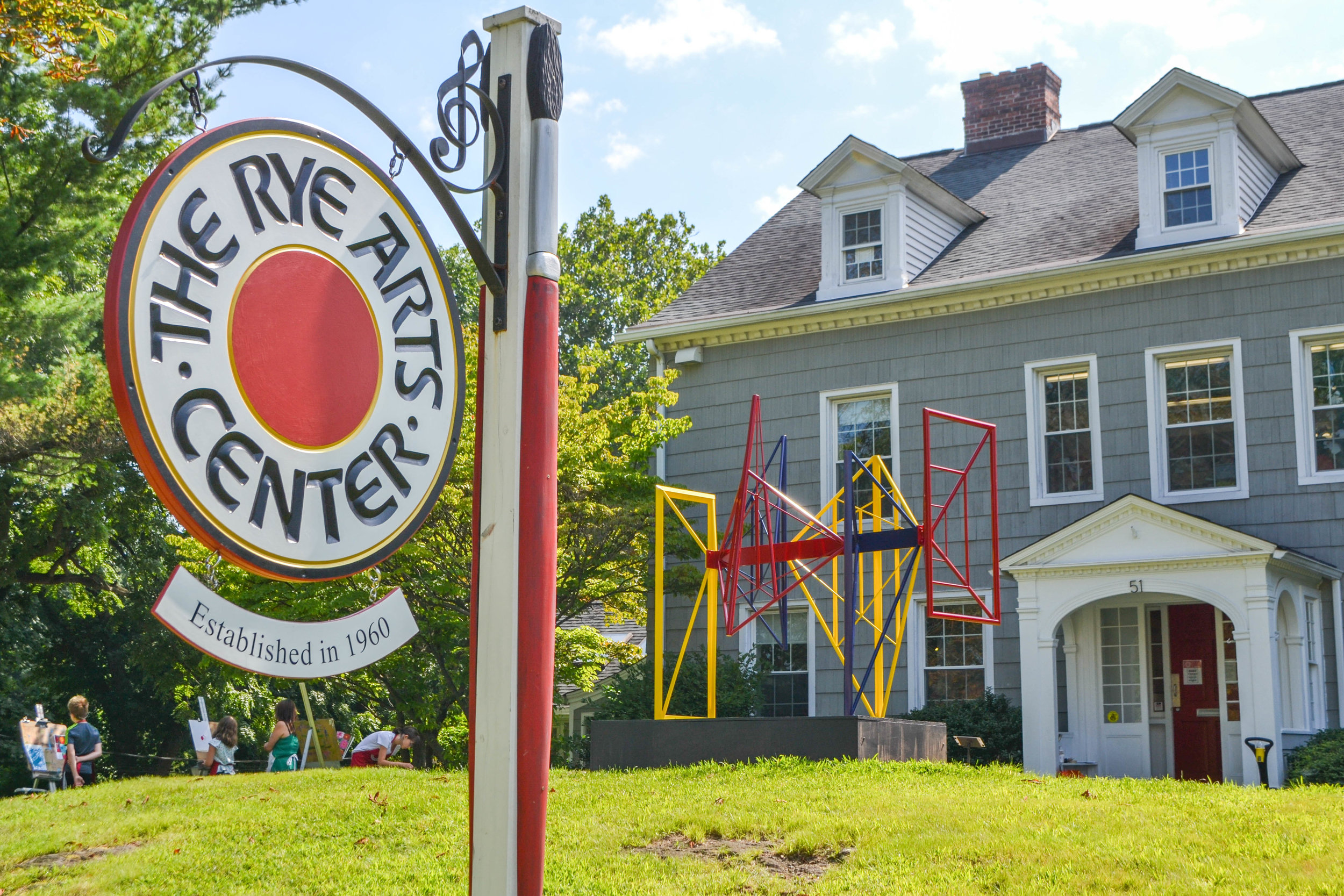
Private Horizon by David Provan
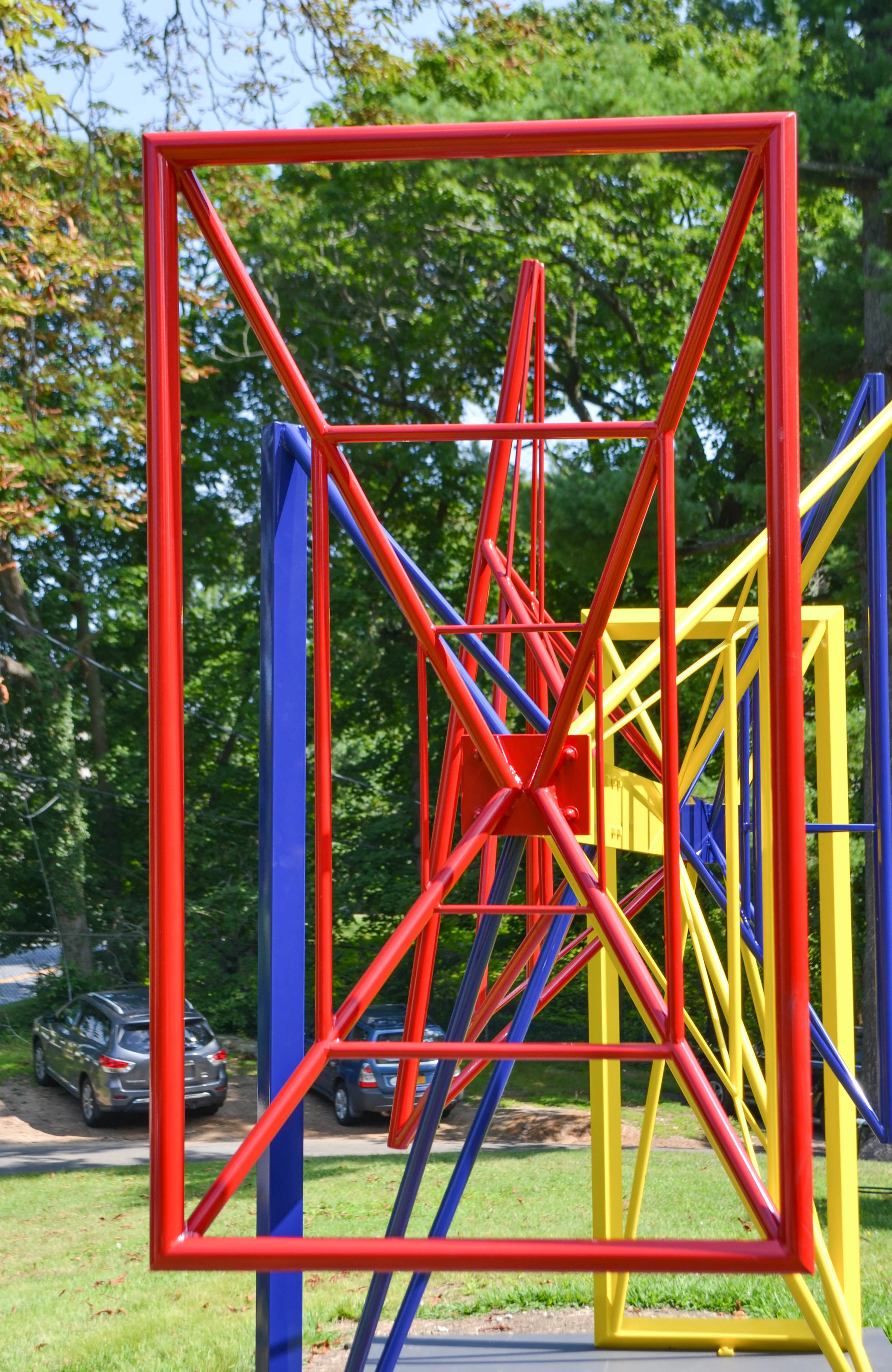
Artist Talk: Thursday, September 7, 6pm
Join us to meet the artist and learn about his process in creating Private Horizon. In addition, a few artists from Painters On Location will be on hand to talk about their work.
About the Artist:
Soon after graduating from high school in California, David Provan joined the Navy, where he flew as an airborne reconnaissance operator in Vietnam. After his discharge, he worked as a carpenter, building houses in Japan and, later, practiced Buddhism at Yang Leshd Monastary in Nepal. Returning to the West, he earned degrees in art and architecture from Yale (B.A. ’79) and the Royal College of Art in London (M.A. ’81). His years in Asia and his interests in art and design coalesced into a long series of sculptures that often embody the ideas of Buddhism and Taoism as manifested in a modernist 21st century design sense.
His work is abstract, but often alludes to the cosmic diagrams of meditation aids of Eastern religions. Provan’s work has been shown in numerous galleries and museums, including Grace Borgenicht Gallery, New York; Mindy Oh Gallery, Chicago; Wenger Gallery, Los Angeles; the Fitchburg Art Museum, MA; and the Seoul Metropolitan Museum of Art, Korea. He has completed several public art projects, including a 200’ installation of kinetic sculptures for the New York City subway, and a design for a series of innovative historical markers for the Municipal Art Society, New York, NY.
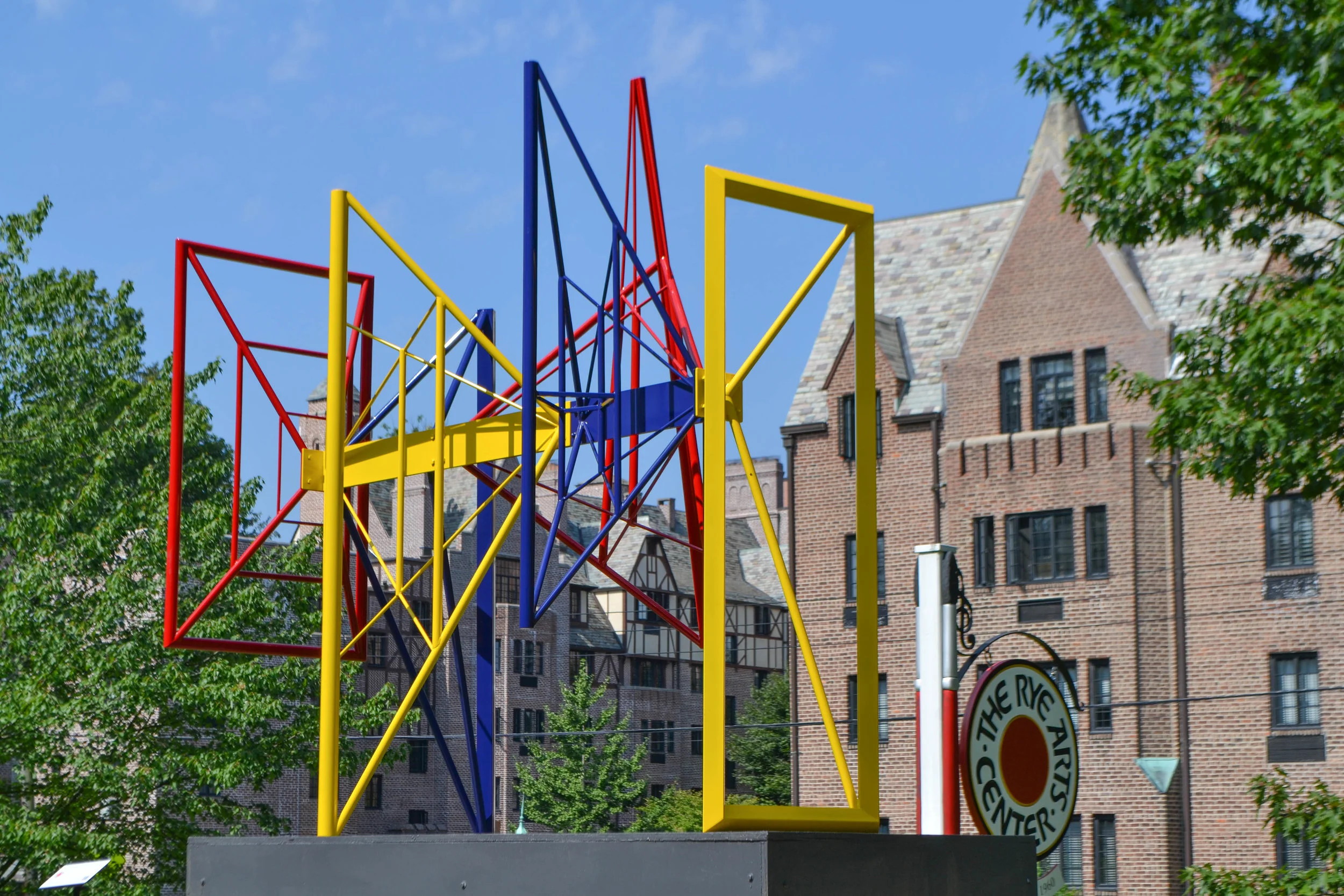
Whispers in the Grove
Whispers in the Grove
Whispers in the Grove, by Kathy Creutzburg, Natalia Lesniak, and Mirabai Kwan Yin
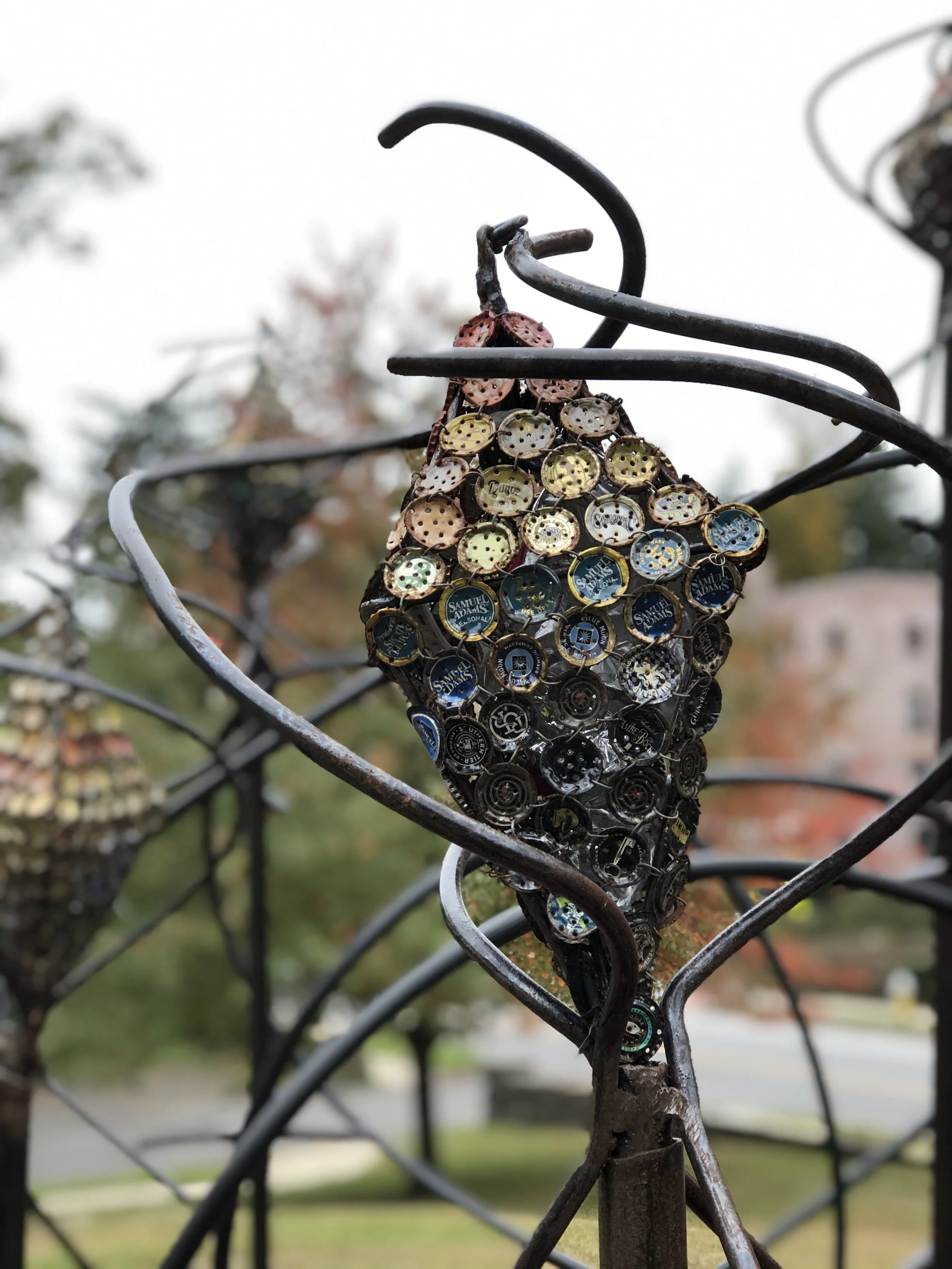
Artists’ Statement:
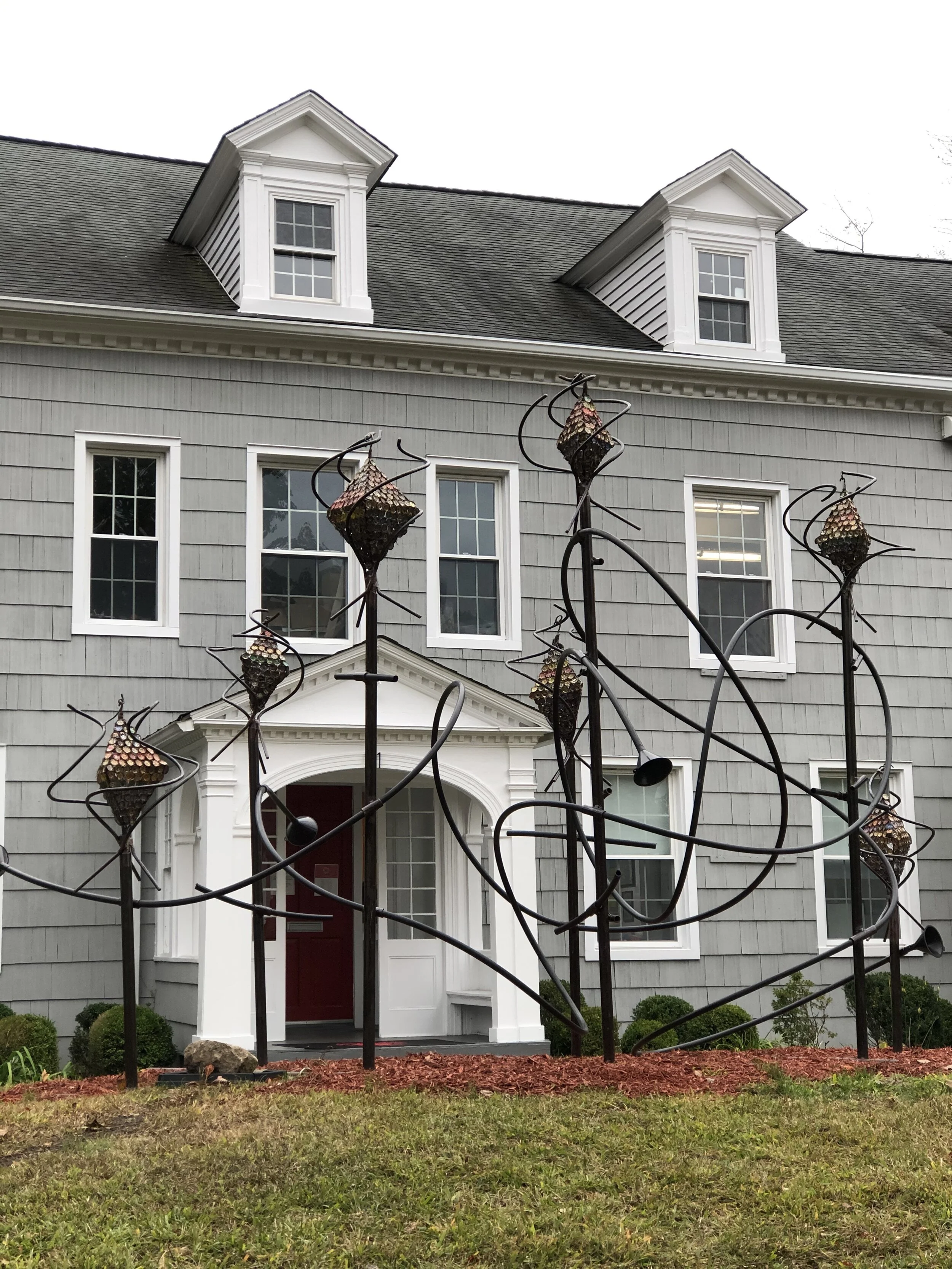
Did you know trees communicate through underground networks of roots and fungus? This woman-made forest of interconnected, neuron-like, steel forms rises to support bulbs, the leaf canopy. Each bulb is enveloped in found materials and illuminated, like fireflies who express through their flicker.
We are inspired by the phenomenon known as mycorrhiza, whereby trees and plants communicate and share resources through a symbiotic relationship between roots and fungus. Our budding understanding of this phenomenon makes humans and plants seem more similar. This network is reminiscent of human neurons, the internet, even our network of roads connecting cities. We all live in symbiosis.
To represent these ideas, we built steel trees topped by cell-like bulbs made of upcycled material from different cities around the USA. Internal lights pulse and shimmer between bulbs. The forest-like structure invites people to wander through or sit beneath it, and voice tubes invite people to whisper to each other from different parts of the sculpture. The poem and soundscape by Nicole Celeste Anderson draw together the concepts that inspired this piece so you too can hear Whispers in the Grove. We seek to pique the public’s interest in science and nature, as well as fostering a sense of interconnectedness of humans and plants, leading to responsible conservation efforts and sustainable practices.
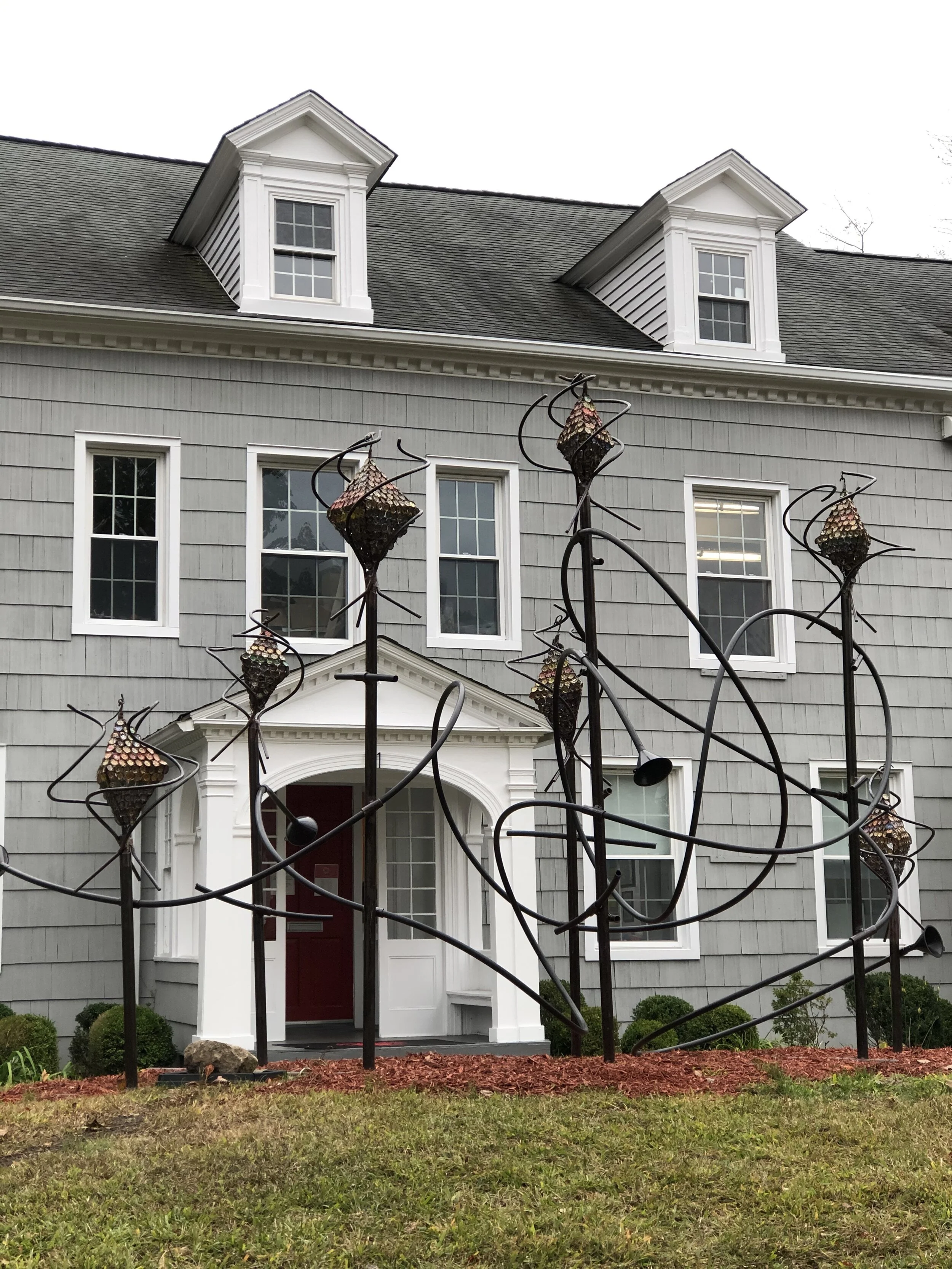
Artists Kathy Creutzburg, Mirabai Kwan Yin, and Natalia Lesniak have been developing Whispers in the Grove for several years, exploring different ways of presenting and engaging with the community. The installation has traveled to many different locations around the New York metropolitan area, disseminating ecological understanding to diverse populations. With each installation the project has developed and has been accompanied by unique programming. At 6BC Botanical Garden, in the Lower East Side, an expert from Trees New York shed light on how trees communicate and work together. The Lower Manhattan Cultural Council sponsored a community event at the Lower East Side Ecology Center’s East River Park Compost Yard, which included a BioBus display of fungi under a high-powered microscope, a composting demonstration, and a planting workshop. In Yonkers, ArtsWestchester enabled us to exhibit at Phillips Manor Hall and give an art workshop for local children. With each new location, the scope of the project and its audience quite literally grew.
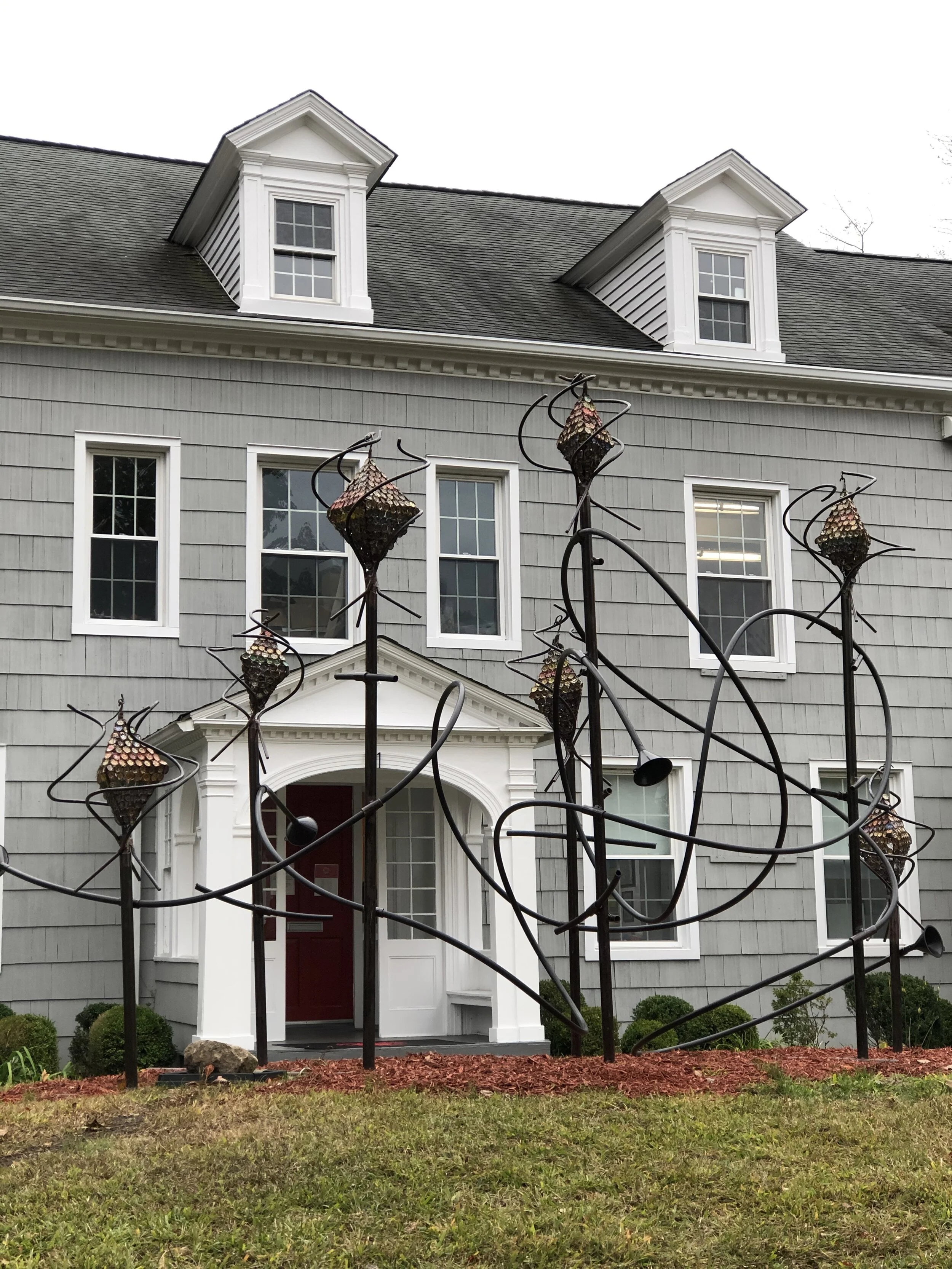
Video by Kris Enos
Whispers in Circles
A Poem by Nicole Celeste Anderson:
Do you ever speak in circles, write in circles, take your hand, and with it, pull the pen in smooth, smooth circles?
Do your stories branch out, reach up, reach down, turn in, turn up, turn to the sky? Who do you tell your stories to? Do you whisper, do you shake, do you giggle, do you wake the others on the floor below?
Do you ever take your hand, and reaching in coastal sand, pull your fingers in smooth, smooth circles?
How do stories travel? Do they travel out of need? Do they travel in a song? Do you write them on the back of a postcard with an old stamp you pulled from the back of the drawer?
Do you find things on the ground, at the foot of trees, in their roots, bottle caps and discarded grocery lists, acorn hats and yellow plastic trash? Do you fish the bottle cap up into your palm, squeeze it until it makes dents in your grip? Do you wonder who left it there? Who lost their shopping list? Whose hand wrote in cursive letters juice boxes, paper towels, sliced cheese, pickles, sunblock, strawberries, hard cider? Did they drop it on the way to the store or lose it after? Do you ever sit still and feel the pulse of all the stories coming to you? - the narratives, faster and lighter than words, darting like reflections at the duck pond on the underside of the bridge.
Do you ever sit still and listen to the hum of humans moving their feet in a train station; tune into one conversation and then the next and then the next, hopping your attention, zooming in, zooming out again? Do you notice the people walking rigidly, the ones who are not talking to each other at all, their silence in the clatter of all the feet? Do you notice the people who lean into each other? And all the ones walking with phone in their hand, looking up and down again, up and down again, to read and to walk forward, texting which gate are we meeting at, again? Texting about dinner, texting about the man they just saw two seats over, playing tag with text messages across the sky, from satellite to smart phone to satellite, the way children would run until dusk, we run at each other with these constructed networks, internet networks, footpaths, subway stations, and the networks of memory, diving into the branches, getting lost.
All of our storylines fall in and out of each other, tie together, tangle, snap, twist, weave. Human life and animal life and plant life, this carbon earthy life, the story of The Where Did You Come From always goes further back to… The day you were born? The day your parent immigrated here? The day your grandfather returned from the war? The day the Spaniards set foot on the continent they later advertised as a new world? But when is a story really new? Generations of cycles, transforming? Deforested strip malls… put up a parking lot.
Who do you tell your stories to? Do you tell them to the tree, who you sat down beneath when you found the grocery list, tired from your walking or maybe from your life? When do you let yourself rest?
How do you ask for what you need? How do you offer what you have to share?
What needs do you omit? What kind of communications do you understand? Is it in their eyes, is it their tone of voice? Is it when they reach out and touch you gently? Is it the way a person carries their words?
The tonal quality of our inflections is an inheritance of birth language and culture – the way we tongue our sentences, the way they leave our mouths, curly, smooth, crackling, dry, percussive, terse, damp, sharp, tart, languid, proud, quiet, forceful, watercolor.
Or even the way we chose to share, what we say – is learned, is listened to, is replicated, we are not the inventors of speech, we are not the originators of mother tongues, we simply twist and shift them, toss and kiss them, and all the woven stories of speaking dent into each other, shape each other, regions snatching slang phrases from each other like hard candy, dialects dancing, slicing, singing, fighting, obscuring… some mother tongues are lost, but the print they made on a family line still whispers in their sleep.
The communications that we share are layered with meanings, some see them and some don’t, depending on which social cues we understand, based on where we grew up, what level of immersion in some academic field or subculture, some cult favorite, what trade of work, which demographic specificity, subset, mainstream or deviation, the discreet and the overt, the dominant culture and the survivor, the transformer, the shape shifter.
And with all these variations on perception, on meaning, on experience, funneling into a very specific style of communication, how do we establish and maintain connection, through these layers and layers and layers of translation, these layers and layers and layers of intention?
Do your stories branch out, reach up, reach down, turn in, turn up, turn to the sky? Who do you tell your stories to?
How do stories travel? Do they travel out of need? Do they travel in a song? Do you write them on the back of a postcard with a stamp you pulled from the back of the drawer?
How do you ask for what you need? How do you offer what you have to share? What needs to do omit? And how do you remember? And does it surprise you that trees speak? Or was it not a surprise at all? Who convinced you of an inanimate world?
Do you ever speak in circles, write in circles, take your hand, and with it, pull the pen in smooth, smooth circles?
Do you ever dream in circles? Clouds shifting above you in crescents that resemble the moon? Mountains obscuring the sun that is rising into a mist, a mist that crawls belly down into the valley – crawling through trees that are singing of the moisture clinging to their leaves, that are resting in family tree clans, awaiting the sweet sugar of morning sun.
Scientists discovered that trees talk to each other. Have you heard this story already? Trees send messages through networks of fungus, they share nutrition with one another, they tell of danger. The elders share their nutrients with the young saplings, shaded at the forest floor, the way we hand feed our toddlers who can’t reach the counter yet.
Do you ever sit still and listen to the hum of saplings moving their leaves near a clearing; do you zoom into one narrow tree that is waving in the morning wind, and then the next tree and then the next, hopping your attention, zooming in, zooming out again? Do you notice the trees standing parallel, the ones who are not swaying in the gusts because they are so sturdy? Their silence in the clatter of the glitter leaf saplings swaying over composting earth floor? Do you notice the gnarled curling trees who lean into each other, who grow at angles around each other? And all the ones growing from old trunks, finding their new roots on the rotten fallen log – they grow in abundance, interwoven roots and damp black soil, the way children would run until dusk, they grow up around each other with these constructed networks, fungus networks, footpaths of hunting cats and curling snakes hiding in their branches, diving into soil, getting lost.
All of their storylines fall in and out of each other, tie together, tangle, snap, twist, weave. Human life and animal life and plant life, this carbon earthy life, the story of The Where Did You Come From always goes further back … do trees tell origin stories? Is their language one that goes beyond need? Beyond sharing of solar heat? Do saplings ask questions? Turn the questions over and over to the elders who hold time in the rings of their memory…
Do you ever dream in circles? Dream of a life that holds you in gentle circles, sit against the foot of the tree and notice that your lives are parallel, you and tree, though you live at different paces, our hearts leap with such fervor, we twist and move and angle about, unable to travel at the same speed as rooted trees, we live parallel, different living species. Do you dream of a balance that replenishes that which is consumed? Bodies in balance, oceans in balance, Forests of ancient tree elders free to sing morning songs to their young and offer them the sweet sugar of morning sun? Do you remember the stories of where you came from? Origin stories can be told at dawn or dusk or even in the midday heat, or even in fluorescent light and hospital sheets.
Do your stories spin in circles, swim in circles, arc dive, weep, cry, freeze, fly, freeze dry silent waiting static circles? Do you tell your stories?
We speak in waves, we speak in need, we speak in praise, we speak in grief,
Offering and receiving,
Translation of light, translation of heat
Translation of life, translation of sleep
Every communication is a translation of experience
From one life to another, as we all explore what it is to be, simultaneously,
And oh,
To be…
We speak of water, we speak of night,
We speak of soil, we speak of light,
And oh, and oh, and oh,
to be, to be, to be
my love, my loves, my love,
breathe with me.
In this shimmering awareness, we find intimacy,
In lunar orbits, nebula dust, in solar heat, we place our trust.
Scales of consciousness, octaves of cells and bodies, scaling up and down,
mammalian tissue, and halo of green chlorophyll canopy lace work crown,
We are of the earth
We are the earth.
We are of the universe
We are the universe.
And oh, and oh and oh, to be.
To be.
The space between your electrons and your yawning soul is as infinite as the sleep-talking humor of Milky Way’s black hole.
Fractals of light, fractals of heat, fractals of life, fractals of sleep.
I am broadened by the mystery. I am deepened by the history,
Millennia of life blood, sun sugar, bone calcium, earth carbon, translated inside of me, secret scrolls of deoxyribonucleic acid, ancient text, branching in a floral web of cellular adornments celebrating me, an interconnected life in a circling, cycling mystery.
We are, we speak, my love, we breathe.


Made possible with funds in part with public funds from Creative Engagement, supported by the New York City Department of Cultural Affairs in partnership with the City Council and administered by LMCC, as well as from the Decentralization Program, the New York State Council on the Arts, Governor Andrew M. Cuomo, the New York State Legislature, and ArtsWestchester.
Window II
Window II
Window II by Natsuki Takauji
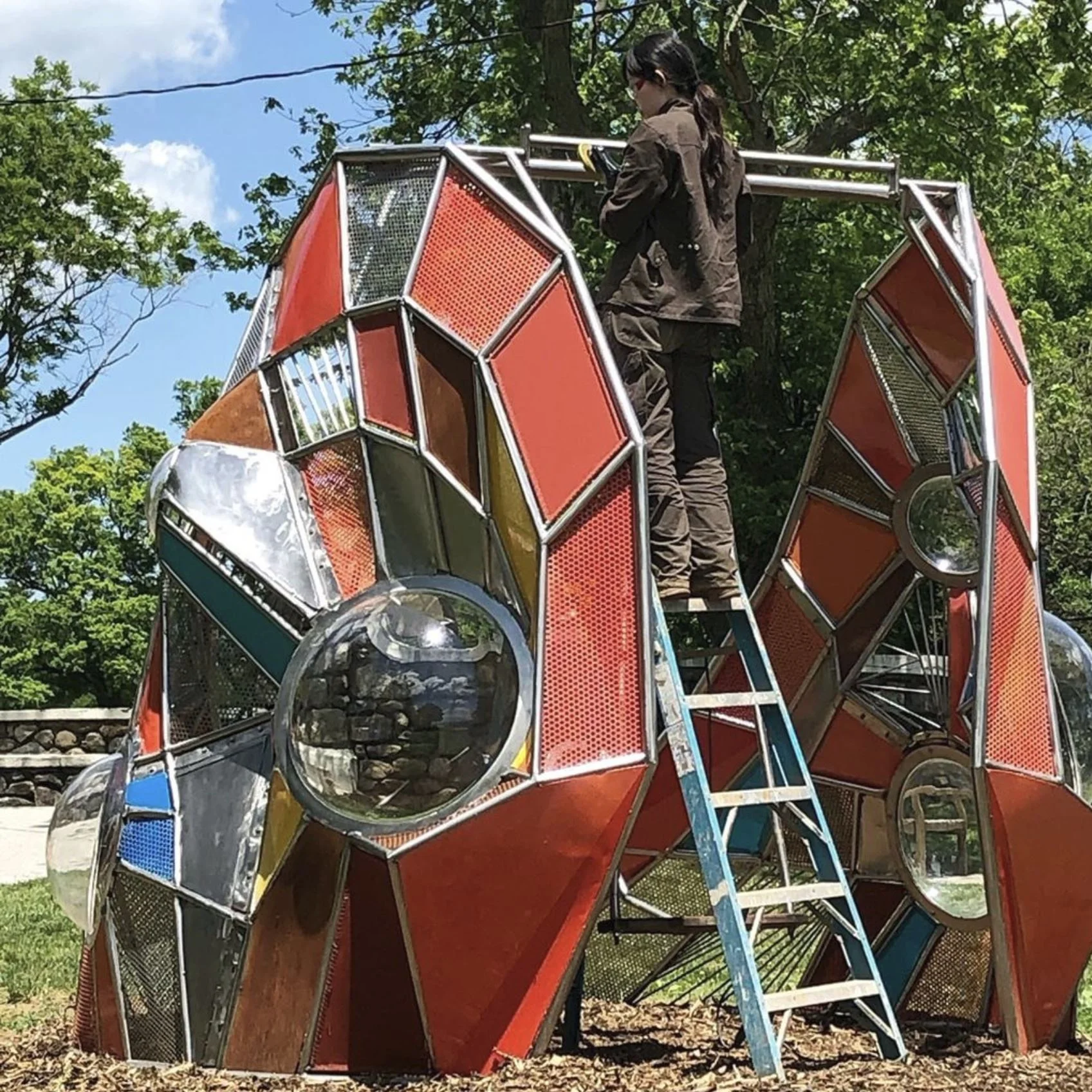
Next time you stroll through Rye Town Park you’ll find a new addition to the landscape. Window II is an interactive sculpture created by New York-based Japanese artist Natsuki Takauji. This new work of art is a functioning swing surrounded by colorful windows. Made of stainless steel, steel, paint, fabric, and acrylic, Window II stands ten feet tall and overlooks the Long Island Sound. You won’t find the typical “do not touch” sign near this sculpture. Instead, visitors are encouraged to climb aboard and enjoy the swing.
The artist shares in a statement:
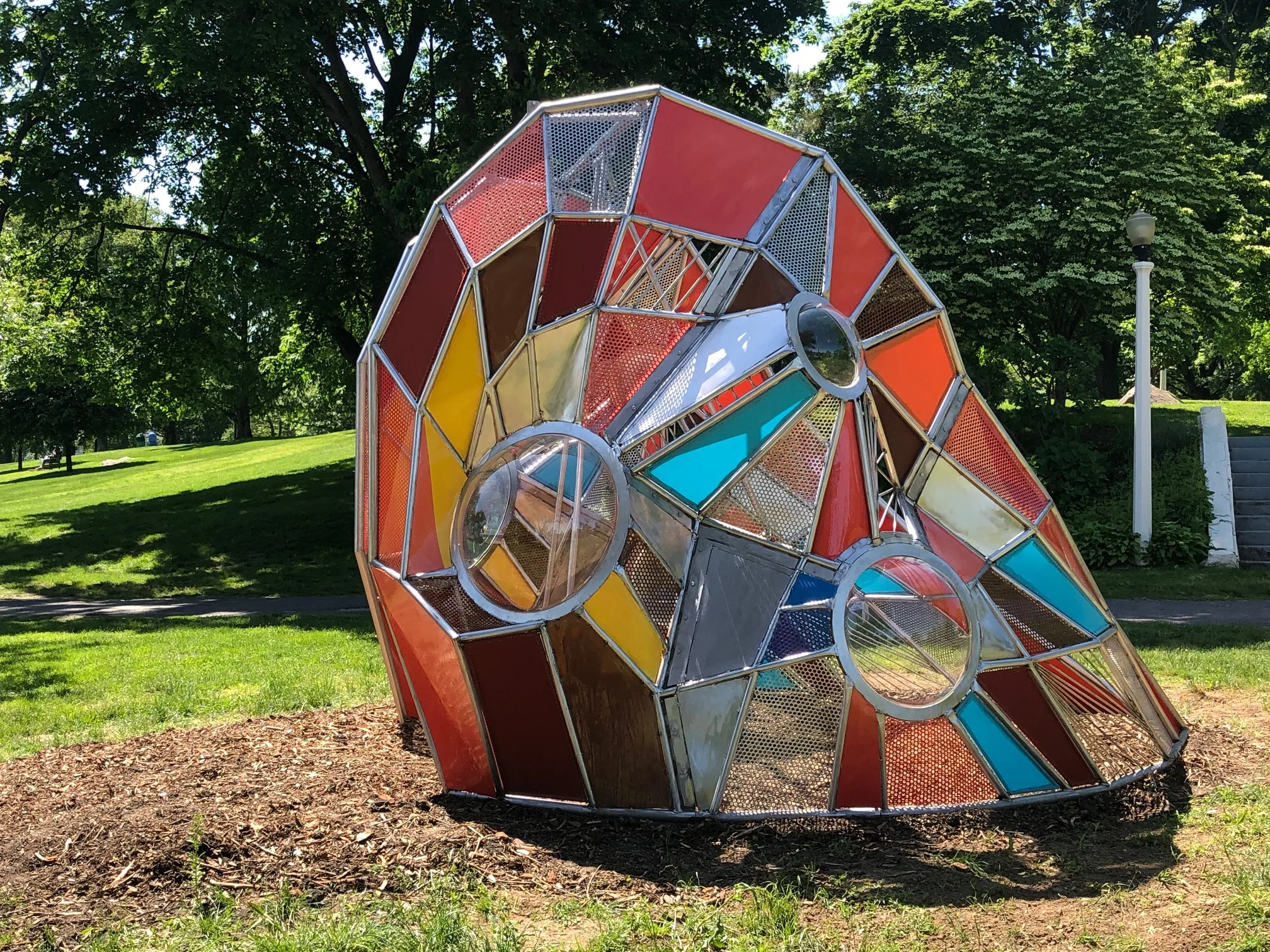
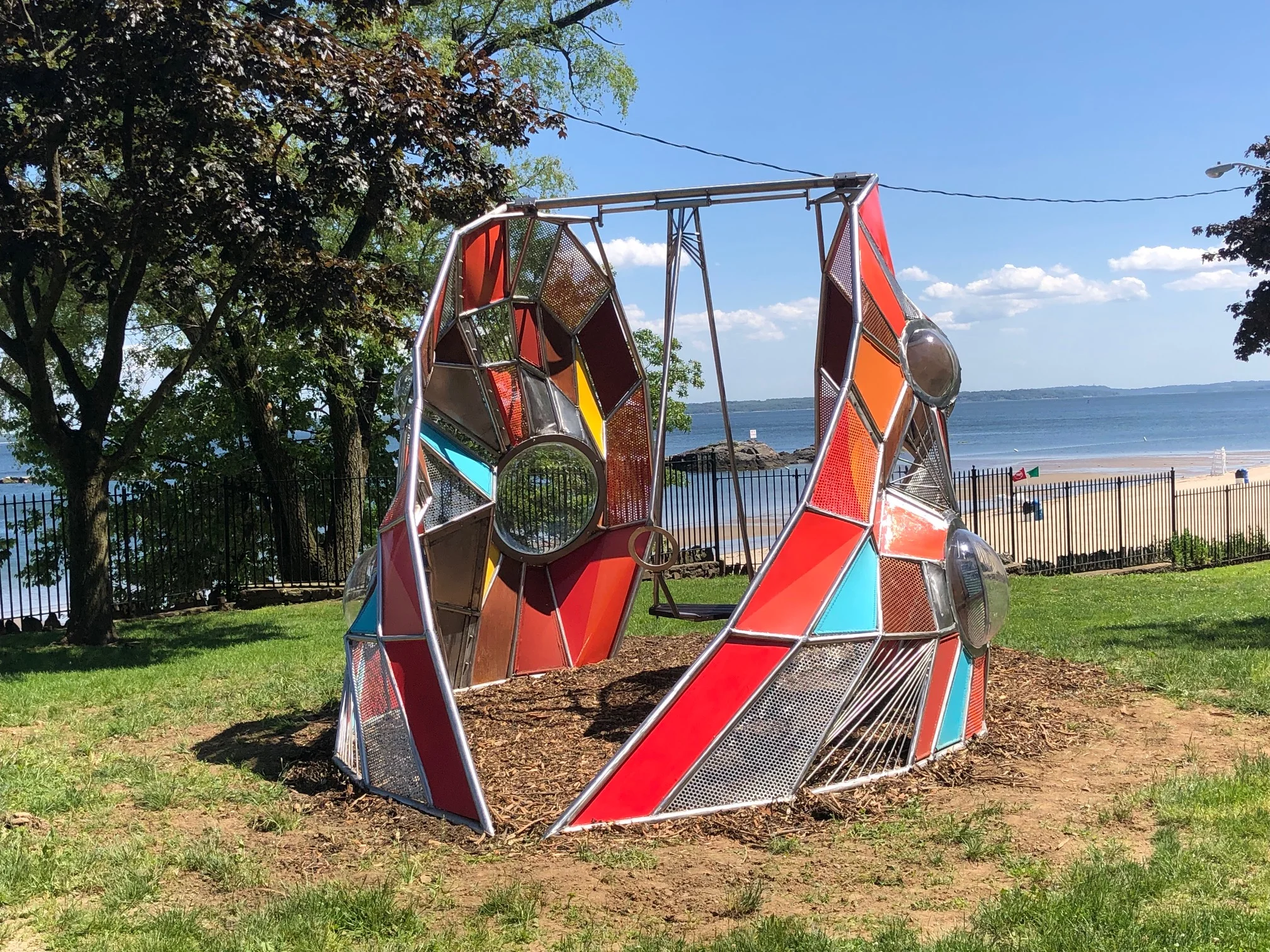
“‘Window’ means our perception. We are seeing everything through some sort of ‘Window’, and I am hoping this interactive sculpture will give a new experience of art in nature, art in public, and also one's perception. Swing is a metaphor of our life, we never stay still, moving from space to space, state to state, emotion to emotion. The design of it can remind us of many things that contain us and move us forward.”
Takauji studied drawing, painting, and sculpture at The Art Students League of New York where she currently teaches metal sculpture. Her work has been shown at the Venice Architecture Biennale, Berkeley College Gallery, Noho Gallery, The Center for Contemporary Art Bedminster, and The Cathedral of St. John the Divine. As the title implies, Window II echoes a previous work by Takauji, Window, which was displayed in Manhattan’s Riverside Park in 2014-2015.
Window II is part of The Rye Arts Center’s Public Art Initiative led by local sculptor, Bob Clyatt. It is a temporary installation and will remain in Rye Town Park for one year.
All are invited to learn more about Ms. Takauji and her work at an artist talk on Friday, July 26, at 5:30 PM. The talk will take place at the sculpture.
Window II is made possible through collaboration with Rye Town Park and the generous support of ArtsWestchester, New York State Council on the Arts, Westchester Community Foundation, and Con-Tech Construction Technology, Inc.
Learn more about the artist:
www.natsukitakauji.com
Instagram: @natsukiuji
Facebook: @windowbynatsukitakauji
Portals
Portals
Portals by Shared_Studios
April 1 – June 30, 2017
“Portals are gold spaces equipped with immersive audiovisual technology. When you enter a Portal, you come face-to-face with someone in a distant Portal live and full-body, as if in the same room.” – www.sharedstudios.com
Developed in 2014 by Shared_Studios, there are now more than 20 Portals located around the world. They provide participants with an opportunity to meet individuals from entirely different backgrounds and cultures. The immersive technology and enclosed setting transcends popular video technologies. When President Obama experienced the Portal at the 2016 Entrepreneurship Summit he said, “It seems like you’re standing right in front of me.”

Current Portal locations include Afghanistan, Jordan, Gaza City, Germany, Honduras, Iraq, Iran, Mexico, Myanmar, Rwanda, and several in the United States.
The art installation is so effective at connecting people from across the world that is has been used by the United Nations to communicate with refugees in war-torn locations. Former U.S. Ambassador to the United Nations Samantha Power said, “You feel you are right there.”
The Portal is more than a large-scale video conferencing tool, and the nature of the experience is disorienting. You forget that you are stateside or in your region of the country. The fact that you will likely never again see the people you encounter provides a freeing sense of anonymity.
“It is about creating a space, context, and moment for a certain kind of dialogue. Our hope is that Portals not only connect public spaces around the world, but revitalize public spaces at home. Even more specifically, we hope it prompts all of us to seek out those moments to converse with strangers unlike ourselves – to put down the iPhone or laptop on the bus or the train and engage the person next to us. Talking to people unlike ourselves is always important, but particularly so today.”
Participants experience a range of curated and open-ended interactions, from simple prompts like “What would make today a good day?” to highly specific engagements.
In addition to one-on-one encounters, the Portal also opens the door to cultural exchanges: teaching artists can present a class, musicians can share their music, dancers can perform, and poets can read their work.
After speaking with students in Gaza City, The Rye Arts Center’s Executive Director Meg Rodriguez shared, “Our lives are so incredibly different, but what our conversation revealed was our similarities.”
The Rye Arts Center unveiled the Portal at Maker Day, on Saturday, April 1. Portals is presented in conjunction with the exhibition Making Their Mark: An Exhibit of Works By Makers.
The Rye Arts Center is working with schools and other organizations to schedule Portal encounters so that thousands of visitors can experience this worldview-changing opportunity. If you represent a school group or organization and would be interested in scheduling a visit please complete reserve a timeslot. We will contact you for details.
Bringing the Portal to The Rye Arts Center was made possible through the generous support of Sherry & Robert Wiener, Gail Harrison Roman, and The Wallace Fox Foundation. Funding was also provided through grants from ArtsWestchester and The New York State Council on the Arts.
